2026 in review: the year AI bills got out of hand
Uber spent its annual AI budget by April, one company reportedly spent $500 million in a month, and most enterprises landed at 2.5 times their plan. Before you set your 2027 AI budget, here's what 2026 taught us.
We are in Q4 now, and most large companies are setting their 2027 AI budgets as you read this. Before they do, it is worth looking back at 2026: the year AI stopped being a small line on the cloud bill and started showing up in board meetings.
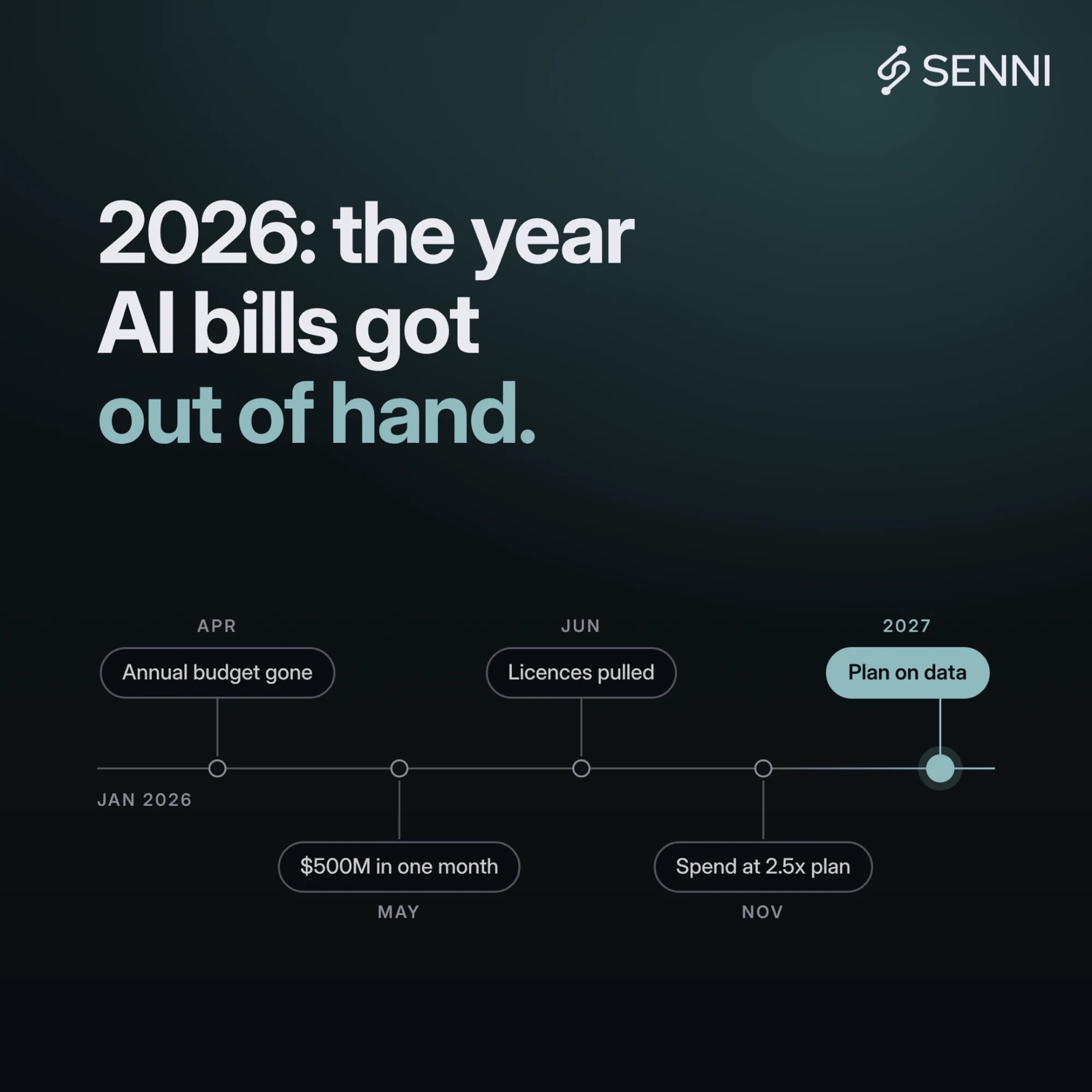
Here are the most striking examples of companies burning money on AI this year, what the wider data says, and what we think it means.
The six stories that defined 2026
1. Uber spent its full-year AI budget by April
Uber rolled out Claude Code to around 5,000 engineers in late 2025. Adoption went from 32% to 84% within a few months, helped by internal leaderboards that ranked usage. By April, CTO Praveen Neppalli Naga told The Information he was "back to the drawing board" because the budget was already gone.
The more telling part came later. At a conference in May, COO Andrew Macdonald said that even with 95% of engineers using AI every month, he could not yet draw a line between that spend and better products for customers. Uber's response was a $1,500 monthly cap per employee, per AI coding tool.
2. The $500 million month
In May, an AI consultant told Axios that one of their clients spent around $500 million on Claude in a single month. The reason was simple: nobody had set usage limits on employee licences. The company was never named and no invoice has been made public, so treat the exact figure with care. But it became the most shared AI cost story of the year because so many finance teams recognised the setup.
3. Microsoft pulled its own engineers' Claude Code licences
Microsoft gave thousands of people in its Experiences and Devices division (Windows, Microsoft 365, Teams, Outlook, Surface) access to Claude Code in December 2025. By May, it was cancelling most of those licences, with a 30 June deadline, and moving engineers to its own GitHub Copilot CLI. Microsoft framed it as the end of a benchmarking exercise. Much of the coverage pointed to the cost of very heavy usage.
4. Priceline's renewal came back 4 to 5 times higher
A routine renewal for an AI coding tool came back four to five times more expensive than the year before. Chris Reed, senior director of IT finance, told TechCrunch the company had started placing token limits on some groups. He also noted that the vendor's usage figures did not match Priceline's internal data. In other words, they were being billed for usage they could not fully see or check.
5. The $40,000 engineer
Faros AI's CEO shared a conversation with a CTO whose engineer spent $40,000 on tokens in one month. The CTO did not know whether to stop him or tell everyone else to work the same way. That one sentence sums up 2026 better than any survey.
6. "3x over budget, and it's only April"
J.R. Storment of the FinOps Foundation said that in April and May he kept hearing the same thing from companies: they were already three times over their token budget for the whole year.
It wasn't just a few big names
The surveys published this year show the same pattern across the market:
- Spend landed at 2.5x plan. Enterprises planned to grow AI spend 1.9x on 2025. They ended up at 4.7x (Menlo Ventures, November 2026, around 400 US enterprises).
- Surprises reached the board. 40% of organisations had to escalate an AI cost surprise to board level, 33% froze spending in an emergency, and 25% delayed or cancelled an AI project because of unexpected costs (Mavvrik, 396 enterprises).
- Forecasts were mostly wrong. Only 11% forecast AI spend within 10% of the actual figure (Mavvrik).
- Some costs never reached finance. 98% of engineering teams use AI coding assistants, but only 42% include those tools in AI cost reporting (Mavvrik).
- Nobody owned the bill. 72% had a surprise AI bill in the past year, 52% have no clear owner for AI costs, and just 13% have basic real-time visibility (Harness, 700 engineering leaders).
- Leaders are worried. 82% of senior leaders at companies investing in AI are concerned about token usage and cost (EY, July 2026).
- The same task can cost very different amounts. McKinsey found cost can vary by up to 30x between runs of the same AI agent.
The pattern: caps after the money is gone
Look at how each story ended. Uber added a per-person cap. Microsoft cancelled licences. Priceline added token limits. Every response came after the money was spent, and every one was a blunt limit rather than a real answer.
The real problem was not that people used AI too much. It was that nobody could see, while it was happening:
- Who was spending: which team, which person, which agent
- On what: which workflow, which model, which task
- For what result: whether the spend produced anything the business valued
Without that, a cap is a guess. It can stop your most productive engineer as easily as your most wasteful agent loop. That is exactly the CTO's dilemma with the $40,000 engineer.
Why this hits large companies hardest
- Scale makes small habits expensive. A few hundred dollars per person per month is easy to ignore in a team of 20. Across 5,000 engineers, it is a budget line the board will ask about.
- Agents don't bill like software seats. A licence costs the same whether it is used for an hour or a day. An agent costs more the more it does, and it can keep going without anyone watching.
- Spend is spread across many tools. Coding assistants, chatbots, internal agents and cloud AI services each send their own bill. Finance sees the total, not the story behind it.
- Regulated firms need to explain the spend, not just pay it. Banks, insurers and fintechs already have to show who did what and why. AI activity that nobody can attribute is a cost problem today and a governance question tomorrow.
Before you sign off your 2027 AI budget
A few questions worth answering first:
- Can you list every AI tool and agent running in the company today? Including the ones teams signed up for themselves.
- Can you see spend by team, person and agent, not just by vendor? A monthly invoice is too late and too vague.
- Does someone own the AI bill? Not engineering, finance and IT each owning a quarter of it.
- Can you link spend to outcomes? If you can't say what a workflow delivers, you can't say whether it is too expensive.
- Will you find out about a runaway agent in minutes or at month end? The answer decides whether a loop costs you hundreds or hundreds of thousands.
If most of those answers are "not really", you are in good company. Based on this year's numbers, so is most of the market.
What we are building at Senni
Senni sits between your organisation and the AI tools and agents your people and systems use. The aim is simple: give you visibility and control over that AI activity before it turns into a surprise, so you can keep the usage that creates value and catch what doesn't. 2026 showed that turning AI off is not the answer. Seeing it clearly is.
Want to see how it works? Book a demo with us.
Sources
- TechCrunch: The token bill comes due (Priceline, $40k engineer, FinOps Foundation, $500M report)
- The Decoder: $500M Claude month, via Axios
- Enterprise DNA: Uber CTO, via The Information
- Forbes: Token billing exposes AI's missing ROI (Uber COO)
- Outlook Business: Uber's $1,500 cap
- The Next Web: Microsoft's Claude Code retreat
- FourWeekMBA: Menlo Ventures, 2026 State of Enterprise AI
- Mavvrik: 2026 State of AI Cost Governance Report
- CFO Dive: Mavvrik findings on developer tools
- FinOps Weekly: Harness, State of AI in FinOps 2026
- Techstrong.ai: EY AI Pulse survey
- Yahoo Finance: McKinsey on agent cost variance